API Security
- APIs is Application Programming Interface
- HackerOne Hacktivity for APIs Link
🗃️ Complete Guide to API Types
This table covers the most common API types, categorized by their underlying architecture/protocol and by their scope/audience.
1. API Types by Architectural Style/Protocol (How they Work)
| API Name / Protocol | Definition | Key Characteristics | Example |
|---|---|---|---|
| REST (Representational State Transfer) | The most common architectural style. Uses standard HTTP methods (GET, POST, PUT, DELETE) to manipulate resources via URLs. | Stateless, flexible data format (usually JSON), simple, and highly scalable. | GET /api/v1/products/456 (Fetching a specific product) |
| SOAP (Simple Object Access Protocol) | A protocol standard that uses XML for message formatting and typically operates over HTTP, SMTP, or other protocols. | Strictly structured, features built-in security and transaction handling (ACID compliance). Often used in enterprise, finance, and healthcare systems. | A Payment Gateway API request to process a secure transaction with a formal XML envelope. |
| GraphQL | An API query language and server-side runtime that lets the client request exactly the data they need and nothing more. | Clients define the response structure, preventing over-fetching and under-fetching. Operates over a single endpoint. | A single query asking for a user's name and their five most recent posts' titles. |
| gRPC (Google Remote Procedure Call) | A modern, high-performance RPC (Remote Procedure Call) framework that uses HTTP/2 and Protocol Buffers for data serialization. | Very fast and efficient communication, often used for internal microservices and high-throughput systems. | A service call like UserService.GetUser(user_id) between two backend services. |
| Webhook | An event-driven API that allows one application to send real-time notifications to another when a specific event occurs. It's a "reverse API." | The server makes an HTTP POST request to a URL provided by the client (a callback URL). | A notification sent to an e-commerce platform when an order is successfully processed by the payment service. |
| WebSocket | A protocol providing full-duplex (two-way), persistent, and real-time communication over a single, long-lived TCP connection. | Ideal for continuous, low-latency data exchange, eliminating the need for constant polling. | The data feed for a live stock ticker or a multiplayer online game. |
2. API Types by Scope/Audience (Who can Use them)
| API Name / Scope | Definition | Audience | Example |
|---|---|---|---|
| Public API (Open API) | An API that is openly available to all external developers with minimal restrictions (sometimes requiring an API key). | The general public, external developers, and any third-party app. | The Google Maps API allowing a website to embed a map. |
| Partner API | An API shared only with authorized external business partners under a specific license or contract. | Specific, trusted third-party companies that have a business relationship with the host company. | An airline sharing its flight manifest API with an online travel agency (like Expedia or Priceline). |
| Private API (Internal API) | An API developed to be used exclusively within an organization to connect different internal systems and services. | Internal development teams and applications within the company's private network. | An internal API connecting a company's HR database to its payroll system. |
| Composite API | An API that bundles the requests for data or services from multiple APIs into a single, unified call. | Developers who need to perform complex operations that require data from several back-end services in one step. | An API call that simultaneously retrieves a customer's profile, their order history, and their support tickets. |
Introduction
- Purpose and Importance of Securing APIs
- Since APIs acts as a gateway between different applications and systems, they are prime targets for cyberattacks.
- Failure to adequately secure APIs can lead to various risks.
- Data Breaches
- Identity and Authentication Attacks
- DoS, DDoS and MiTM Attacks
- API Abuse
Deep Dive in APIs
- GRAPHQL, SOAP, REST
REST API
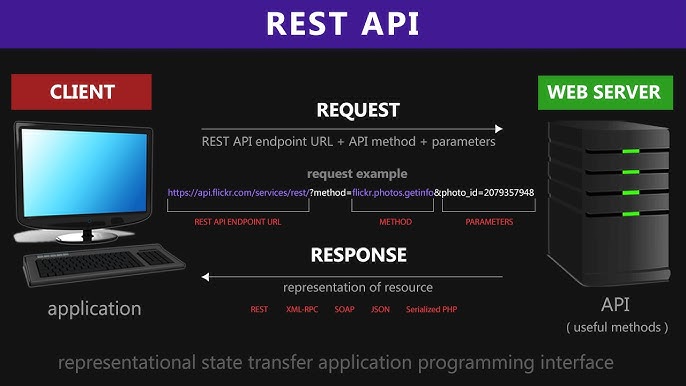
- REST (Representational State Transfer) is an architectural style for designning networked applications, and it is widely used for building APIs.
- RESTful APIs are based on a set of constraints that leverage HTTP methods and status codes for communication between clients and servers.
- REST APIs use simple and intuitive URLs to represent resources, and they support various data formats like JSON and XML.
SOAP API
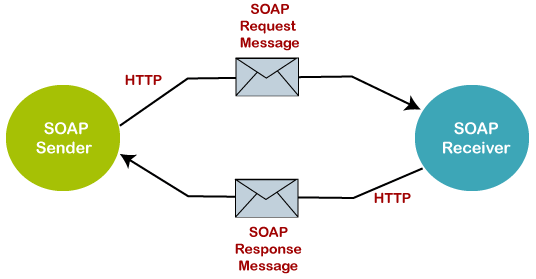
- SOAP (Simple Object Access Protocol) is a protocol for exchanging structured information in the implementation of web services.
- It uses XML to define the message format and relies on HTTP, SMTP, TCP and other transport protocols for message delivery.
- SOAP APIs are considered more rigid and complex compared to REST APIs due to their reliance on XML and a set of strict standards.
GRAPHQL
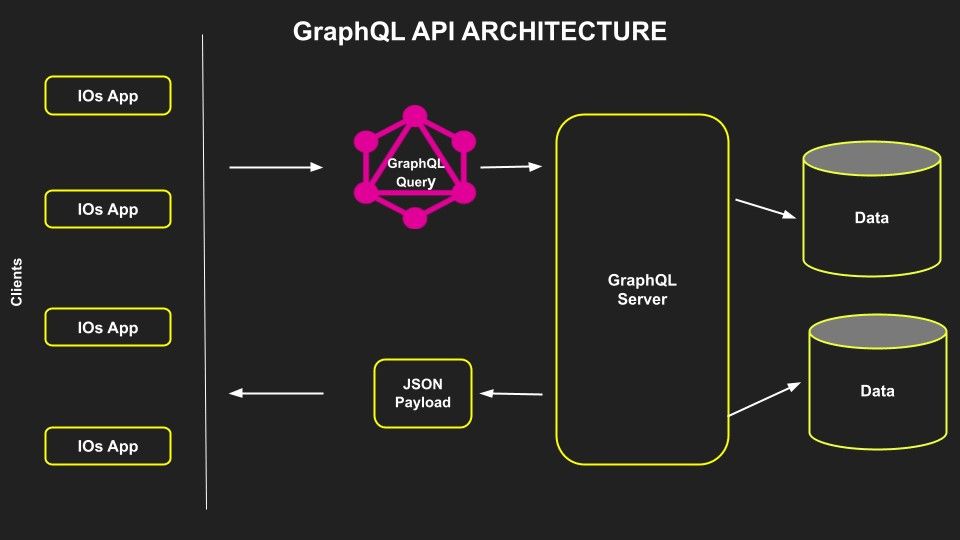
- GraphQL is a query language for APIs developed by Facebook.
- Unlike REST and SOAP, GraphQL allows clients to request only the specific data they need, making it more flexiable and efficient in data retrieval.
- With GraphQL, clients can define the shape of the data they want, and the server responds with the exact data in a single request.
| REST | SOAP | GRAPHQL |
|---|---|---|
| Social Media APIs: Facebook, Twitter and Instagram | Enterprice Web Service: News aggregators, blogging platforms, and content-heavy websites | Content-Rich Applications: News aggregators, blogging platforms, and content-heavy websites |
| E-Commerce APIs: APIs for online marketplaces like Amazon and eBay | Financial Services: Transactions, account management, and data retrieval | Personalized Experiences: E-commerce platforms |
| IoT APIs: Control smart devies, such as thermostats, smart home assistants, and wearables | Government Services: Tax filing, social security benefits, and online permit application. | Data Aggregation: E-Commerce product catalog |